Mesothelioma Life Expectancy
Mesothelioma Life Expectancy
Average life expectancy for mesothelioma
patients is 12 to 21 months. How long a patient lives depends on several
factors including age, stage of the disease, and overall health.
Approximately 40 percent of patients live past one year; 9 percent live
longer than 5 years.
Malignant mesothelioma
is an aggressive form of cancer whose symptoms typically don’t show up
until later stages. Therefore, life expectancy for mesothelioma patients
is generally short, especially without treatment. Life expectancy
varies significantly from patient to patient based on a number of
individual factors and circumstances. Long-term survival is extremely
rare, with fewer than 10 percent of patients living beyond 5 years.
Early detection and quality health care are the most important factors in improving one's prognosis.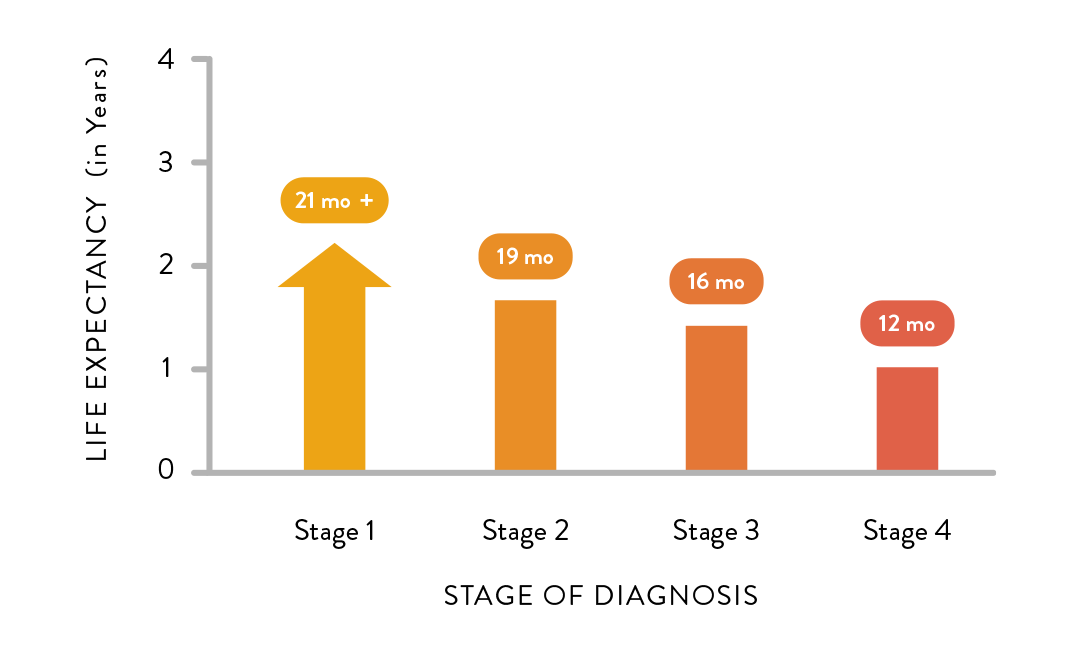
Factors Affecting Life Expectancy
The life expectancy of a mesothelioma patient is a complex thing to determine, as it depends on a variety of factors.Stage
An early diagnosis can improve life expectancy significantly. When diagnosed at an early stage (Stage I or Stage II), there is little or no spreading, and treatments are likely to be more effective. However, at Stages III and IV the mesothelioma has expanded beyond the initial location, which makes treatment more difficult.Mesothelioma Location
Another big factor that can affect life expectancy is where the mesothelioma develops. Historically, patients with pleural mesothelioma have had a slightly longer life expectancy than those with peritoneal mesothelioma, while patients diagnosed with peritoneal mesothelioma have a very short life expectancy. However, in recent years, the life expectancy of patients diagnosed with peritoneal mesothelioma has improved, due to the development of more effective treatments.Patient Age
Generally, older mesothelioma patients have shorter life expectancies, mostly because they are in poorer health and the disease is likely to be at a later stage. One study showed that individuals diagnosed with pleural mesothelioma before the age of 65 lived almost 4 months longer than those diagnosed at age 65, and more than 8 months longer than those diagnosed at age 75 or older.| Pleural Mesothelioma Life Expectancy by Age at Diagnosis |
||
|---|---|---|
| Up to 65 years | 12 months | |
| 65+ years | 8 months | |
| 75+ years | < 4 months | |
Cell Type
Mesothelioma can be categorized into three different cell types: epithelioid, sarcomatoid, and biphasic (a mixture of both epithelioid and sarcomatoid cells). Typically, those with epithelioid mesothelioma have a significantly longer life expectancy than those with sarcomatoid mesothelioma, while those with biphasic mesothelioma have a life expectancy in-between. Pleural Pleural |
 Peritoneal Peritoneal |
|
|---|---|---|
 Epithelioid Epithelioid |
19 months | 54 months |
 Biphasic Biphasic |
13 months | 4.6 months |
 Sarcomatoid Sarcomatoid |
8 months | Not enough data |
Patient’s Sex
Fewer women have mesothelioma than men, mostly due to occupational differences and risk of asbestos exposure, and life expectancy in women diagnosed with mesothelioma tends to be longer than for men. In general, women diagnosed with mesothelioma live about 5.5 months longer than men with mesothelioma.Other Factors Affecting Mesothelioma Life Expectancy
Many other factors can go into determining a patient’s life expectancy, from overall health of the individual to gender to certain genetic factors. The table below provides a list of things that can affect life expectancy positively and negatively.| Positive Factors | Negative Factors | |||||||||||||||||
|---|---|---|---|---|---|---|---|---|---|---|---|---|---|---|---|---|---|---|
| No history of smoking | History of smoking | |||||||||||||||||
| Normal white blood cell count | Elevated white blood cell count | |||||||||||||||||
| Low hemoglobin level | High hemoglobin level | |||||||||||||||||
| Low platelet count | High platelet count | |||||||||||||||||
| No symptoms | Symptoms present |
How these factors affect life expectancy can vary significantly from individual to individual.
Life Expectancy and Mesothelioma Treatment
Patients diagnosed with early-stage mesothelioma may be eligible
for an aggressive treatment program, such as involving surgical removal
of the tumor combined with chemotherapy or radiation. The surgery is an
extensive procedure, so the patient must be in generally good health and
not advanced in age.


Comments
Post a Comment